Custom Bar Mats for Nightclubs and High-Volume Bars: Speccing a Set That Survives the Rush
A nightclub bar is a different machine than a cocktail lounge. The pour is faster, the spills are bigger, the lighting is darker, and the same eight feet of stainless rail might see a thousand drinks in a night. Bar mats that work fine in a quiet neighborhood spot get overwhelmed here: they slide, they overflow, and their branding disappears the moment the house lights drop. Speccing mats for a high-volume venue means thinking about coverage, drainage and durability first, and treating the logo as the thing that has to survive all three.
This guide walks through how to choose and size custom bar mats for nightclubs, music venues and any bar where the well never stops moving.
Rail mats and service mats do different jobs
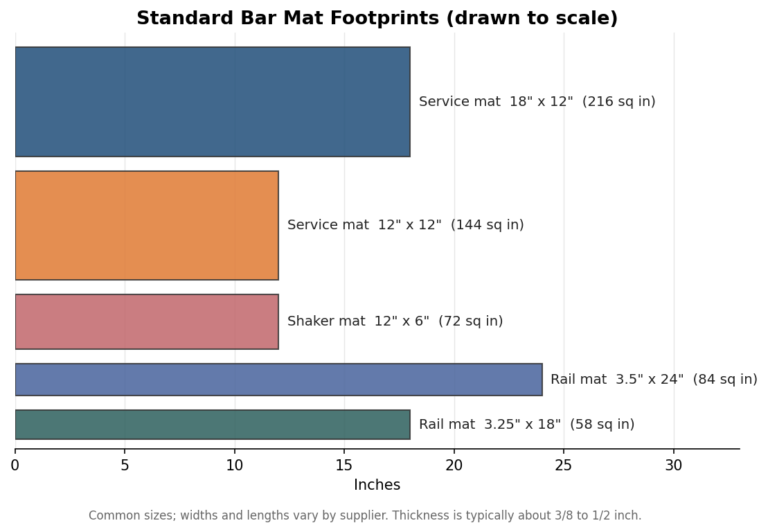
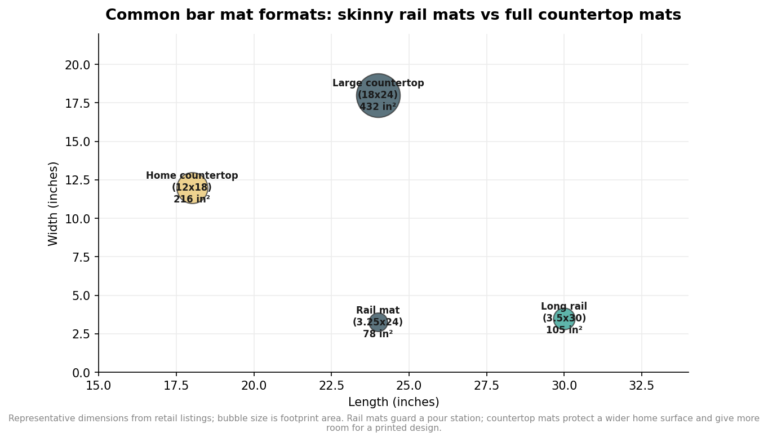
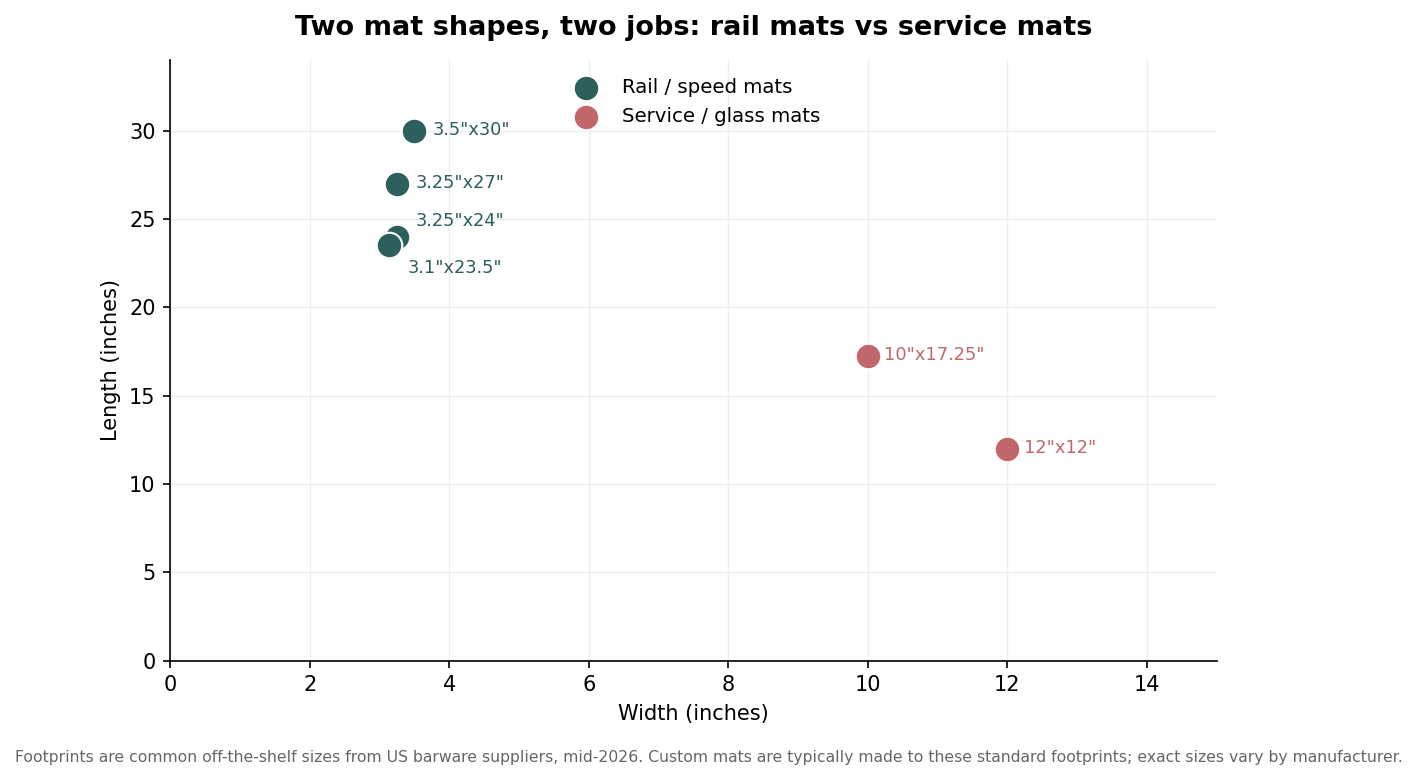
High-volume bars use two shapes of mat, and they are not interchangeable. Rail mats, sometimes called speed mats, are long and narrow, running along the drink rail where bartenders build and set down drinks. Common footprints are roughly 3.25 by 24 inches, 3.25 by 27 inches and 3.5 by 30 inches. They catch the constant drip of a fast pour and give glassware a non-slip landing. Service mats, sometimes called glass mats, are squarer, in sizes like 12 by 12 inches or about 10 by 17 inches, and they sit at the pickup point or under the well where bar-backs stage and drain glassware.
In a busy club you want both. The rail mats cover the working length of the bar; the service mats sit on top of that coverage at the two or three points where volume concentrates. Mapping which mat goes where before you order keeps you from buying ten rail mats when what you actually needed was six rail mats and three service mats.
Cover the whole rail, then add for the wells
The single most common mistake in a high-volume bar is buying too few mats and leaving bare stainless between them. Bare gaps are where drinks get set down, spilled and never caught, and they are where the floor mats behind the bar start taking the overflow. Cover the working rail end to end.
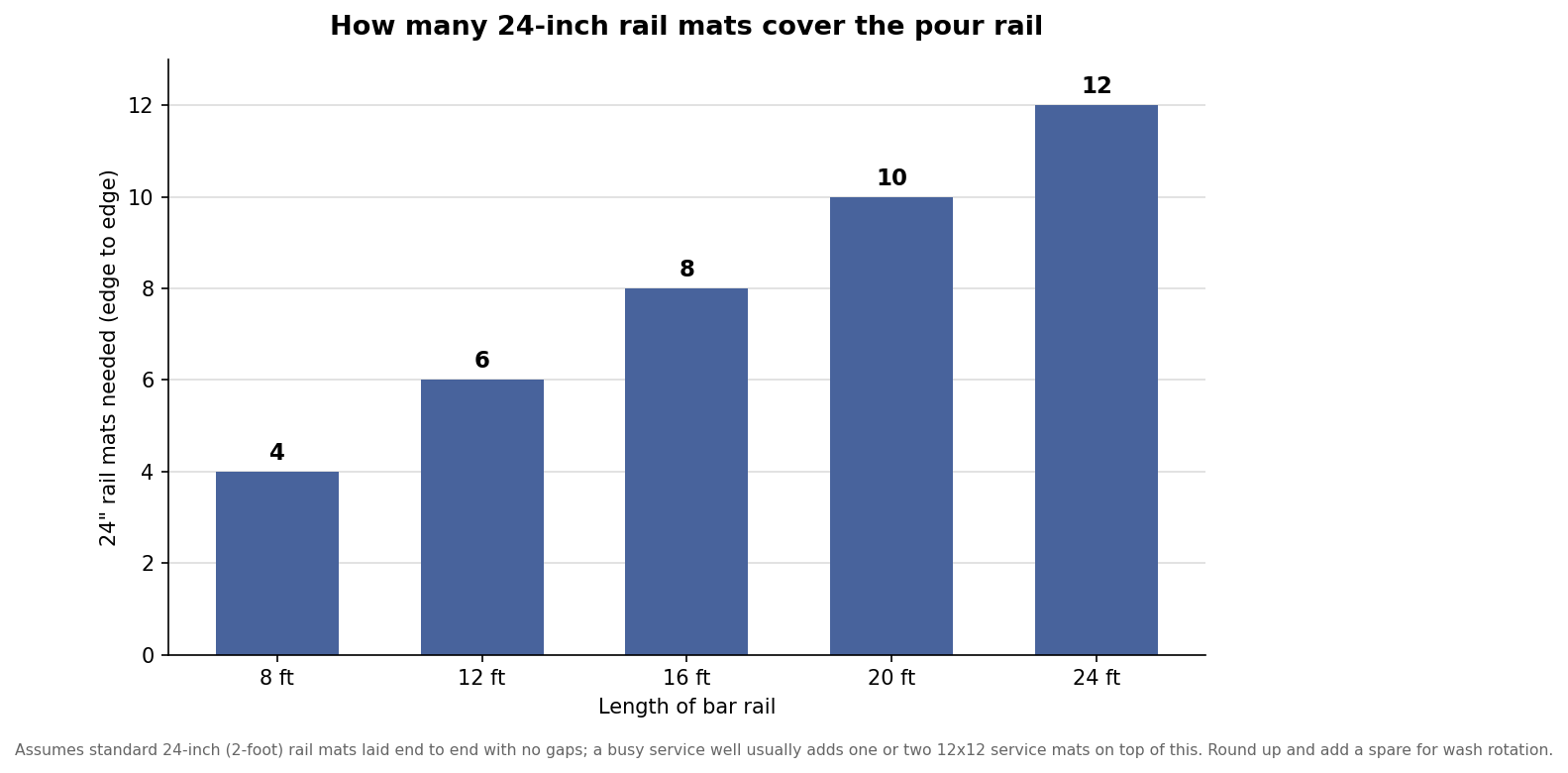
The math is simple. A standard 24-inch rail mat covers two linear feet, so an eight-foot bar needs four mats laid edge to edge, a sixteen-foot bar needs eight, and a twenty-foot bar needs ten. The chart below shows that progression. On top of full rail coverage, add a 12-by-12 service mat at each pour station and pickup point, and then order at least one or two spares beyond that number so there is always a clean, dry set ready while the others are being washed.
That wash rotation matters more in a club than anywhere else. Mats that are pulled, rinsed and swapped every night last longer and stay grippy, but only if the venue owns enough of them to rotate. A bar that owns exactly the number it needs on the rail ends up running dirty, sliding mats because there is never a spare set to swap in.
Thickness and compound decide how long they last
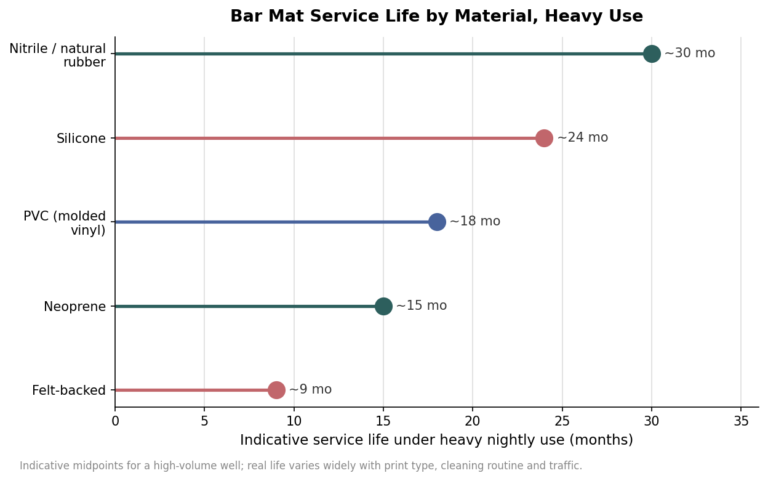
Bar mats are commonly offered in 8, 10 and 12 millimeter thicknesses. In a low-traffic setting 8 millimeters is fine, but a high-volume bar should default to the thicker end. A 10 to 12 millimeter mat holds more spill volume in its channels before it overflows, resists curling at the edges, and takes the repeated slam of a shaker tin or a stack of rocks glasses without deforming. The extra rubber is cheap insurance against a mat that has to be replaced twice a year.
The rubber compound and the underside matter just as much as thickness. A heavier mat with a textured, non-slip base stays put on a wet stainless rail, while a thin, light mat creeps around during service and becomes a hazard. If a supplier offers a choice, a denser rubber with a defined nub or waffle backing is the right call for a club. Ask specifically about the base, because two mats that look identical from the top can behave completely differently once the rail is wet.
Branding that reads in the dark
A nightclub is the one venue where your mat branding is fighting the lighting. Deep-cut or debossed logos vanish in low light because they rely on shadow, and a dark logo on a black mat disappears entirely once the room goes dim. If the point of the mat is brand visibility, and in a sponsored or brand-activation setting it usually is, specify a light-colored or high-contrast logo against the mat color, and lean toward a raised 3D logo or a filled, colored print rather than a subtle deboss.
Color that pops under stage lighting and UV is worth testing before you commit to a full run. The safest path is to order a single pre-production sample and look at it under the actual bar lighting, not under office fluorescents, because a color that looks bold on a screen can read as muddy under colored club lights. Getting the contrast right is the difference between a mat that markets a brand all night and one that is just a black rectangle nobody can read.
Putting the spec together
For a high-volume bar, a defensible starting specification looks like this: rail mats sized to cover the working rail end to end with no gaps, a 10 to 12 millimeter thickness, a dense compound with a non-slip textured base, a couple of 12-by-12 service mats at the busy stations, a high-contrast or raised logo built for low light, and enough total pieces to keep a clean set rotating while others are washed. Nail those decisions and the mats will keep up with the room. Treat them as an afterthought and you will be mopping the floor behind the bar every night and reordering before the season is out.