Ordering Custom Bar Mats: Five Mistakes That Cost Bars Money
A custom bar mat is a cheap product to order badly. The mat itself might cost a few dollars, but a run that arrives too thin, in the wrong material, with a logo that fills in after a month of washing is money spent twice. Most of those outcomes trace back to a handful of decisions made before artwork is ever sent. Here are the mistakes that cost bars and beverage brands the most, and how to avoid each one.
Mistake 1: buying on price without matching material to traffic
The cheapest quote almost always wins the order, and it is frequently the wrong mat. A felt-backed or thin PVC mat behaves fine on a quiet back bar and falls apart in a busy well, where nightly exposure to citrus, sanitizer, and dragged glassware chews through soft material fast. Match the material to the station, not to the invoice. Nitrile or natural rubber tolerates the abuse of a high-volume well far longer than felt or lightweight vinyl; silicone sits in between, flexible and easy to clean but softer underfoot. The chart below shows indicative service life under heavy use, and the spread is wide enough that a material chosen to save a dollar can cost you a reorder two seasons early.
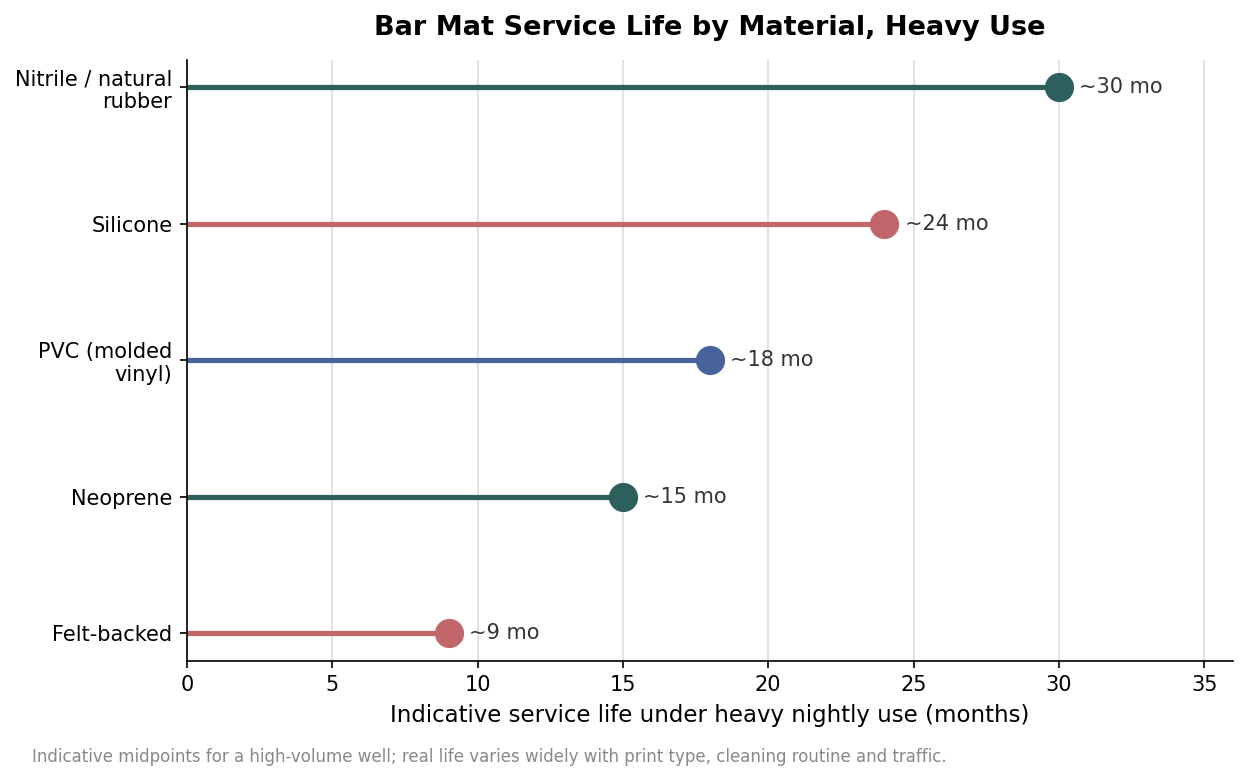
Read those numbers as a heavy-use benchmark rather than a warranty. A rubber mat on a wine bar that pours two hundred glasses a week will outlast the same mat behind a cocktail well doing two thousand. The point is directional: the softer and cheaper the material, the sooner it goes in the bin, and for a working bar the labor of swapping mats usually outweighs the material savings.
Mistake 2: getting the thickness wrong for the job
Thickness is where buyers over-correct in both directions. Too thin and a rail mat offers no cushioning and curls at the edges; too thick and a service mat rocks under a shaker or refuses to sit flush where cabinetry is tight. The station dictates the answer. A rail mat in the well benefits from more material because it takes the most punishment and the most standing glassware, while a drip or glass-drying mat can run thinner because it is not absorbing impact. Spec thickness by where the mat lives, not by a single house standard applied everywhere.
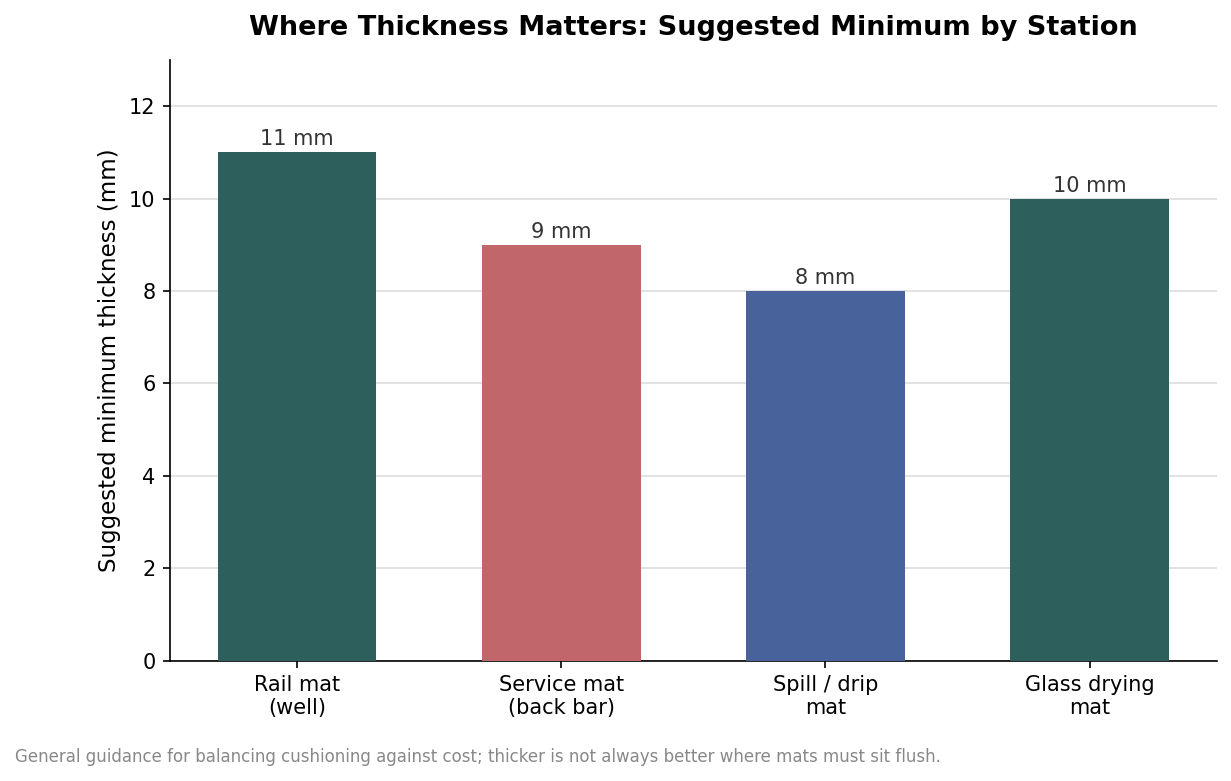
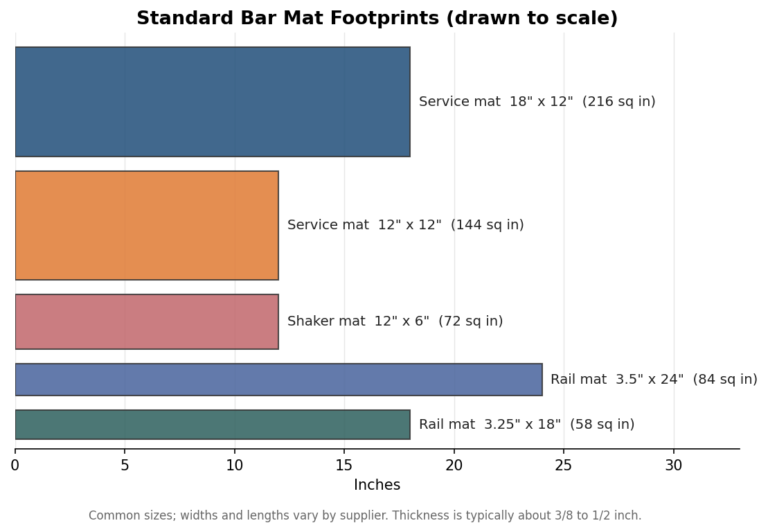
Those figures are starting points for balancing cushioning against cost, and there is a practical ceiling: a mat that sits proud of a recessed well or a drip tray lip becomes a trip-and-slide hazard for glassware, so flush placement sometimes trumps the extra millimeters. When in doubt, measure the recess the mat has to sit in before choosing.
Mistake 3: sending artwork the process cannot reproduce
This is the most avoidable mistake and the one that ruins the most orders. Bar mats are typically decorated in one of three ways, and each has hard limits. Screen printing lays ink on the surface and handles bold, flat colors well but struggles with fine gradients and very thin lines. A debossed or 3D raised-rubber logo is molded into the mat, which looks premium and never wears off, but it requires tooling and reproduces detail as raised or recessed shape rather than color. Send layered vector artwork, not a low-resolution logo pulled off a website. Vector art lets the maker separate colors for screens or cut a clean mold; a small JPEG forces a redraw and invites the fill-in and fuzzy edges that show up after a few wash cycles.
Two details save the most grief. Keep line weights and small text above the process minimum, because a hairline that survives on screen closes up in molded rubber. And if the logo is going raised rather than printed, simplify it: fine serifs, thin outlines, and tight negative space that read perfectly in print can turn to mush as physical relief. Ask for a proof or a digital mock of the molded version before approving the run.
Mistake 4: ordering the wrong quantity for the method
Quantity interacts with decoration in a way that trips up first-time buyers. A 3D molded mat carries a one-time tooling cost to cut the mold, which is why molded runs usually come with a higher minimum and a setup fee, and why ordering fifty molded mats can cost nearly as much per piece as ordering fifty printed ones costs for two hundred. If you only need a small batch, printing is almost always the more economical decoration. If you are committing to a signature mat you will reorder for years, the molded tooling amortizes across every future run and the premium disappears. Decide whether this is a one-off or a standing SKU before you pick the decoration method, because that choice sets your real per-unit cost more than the mat material does.
Mistake 5: ignoring lead time and the cleaning reality
Two operational details get skipped in the rush to approve a design. First, lead time: a custom mat is not a stock item, and between proofing, tooling where required, production, and shipping, a typical order runs on the order of two to four weeks from artwork sign-off, longer for molded work or overseas production. Order for a grand opening or a sponsorship activation with that window in mind rather than the week before. Second, the print has to survive cleaning, and the wrong routine destroys good artwork. Rinsing and gentle washing preserve a screen print; running mats through a harsh chemical cycle or a high-heat dishwasher repeatedly is what fades the logo everyone blames on the printer. Choosing a molded logo sidesteps the fading entirely, which is part of why high-turnover bars often justify the tooling cost. Plan the reorder cadence around honest wear, and a custom mat stays a marketing asset instead of becoming a monthly expense.