Bar Mats for Home Bars: How to Size, Choose, and Personalize One
A bar mat is one of those accessories that looks trivial until you own a nice countertop. The rubber mat that lives behind a commercial bar exists to catch drips, cushion glassware, and give bottles a non-slip home, and every one of those jobs matters just as much at a home bar or coffee station. What changes at home is the context: lower volume, a countertop you actually care about the look of, and the fact that a personalized mat makes a genuinely good gift. This guide walks through how to pick a bar mat for a home setup, what to change versus a commercial spec, and where a custom design fits in.
How a home bar changes the brief
Behind a busy commercial bar, a mat is a workhorse. It gets slammed with hundreds of pours a shift, hosed down nightly, and judged only on durability and drainage. A home bar asks for something a little different. You are not draining a service well every ninety seconds, so raw throughput matters less. You care more about how the mat looks on a visible counter, whether it is quiet and pleasant to set a glass on, and how easy it is to clean in a normal kitchen rather than a commercial sink. And because a home bar is personal, the mat is often chosen the way art is chosen, to fit the room, or bought as a gift with a name or logo on it.
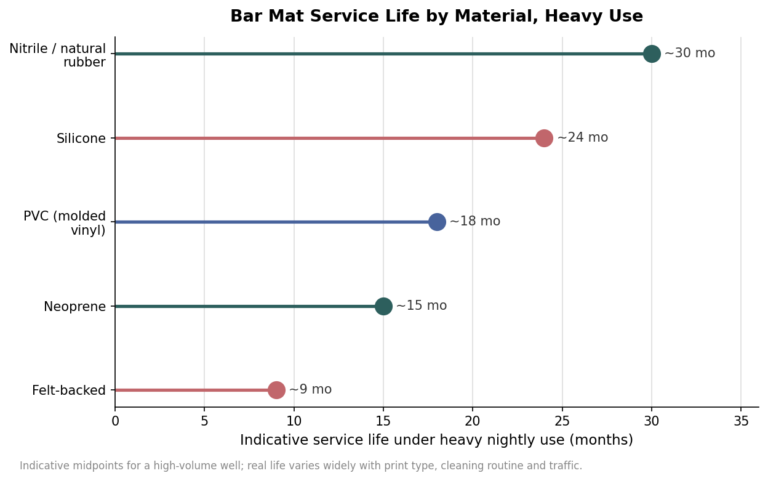
That shift in priorities does not mean buying a flimsier product. The same rubber that survives a nightclub will happily outlast a home bar by a decade. It means weighting your decision toward fit, finish, and personalization rather than pure heavy-duty endurance, while still getting the drainage and grip that make a mat worth having.
Getting the size right
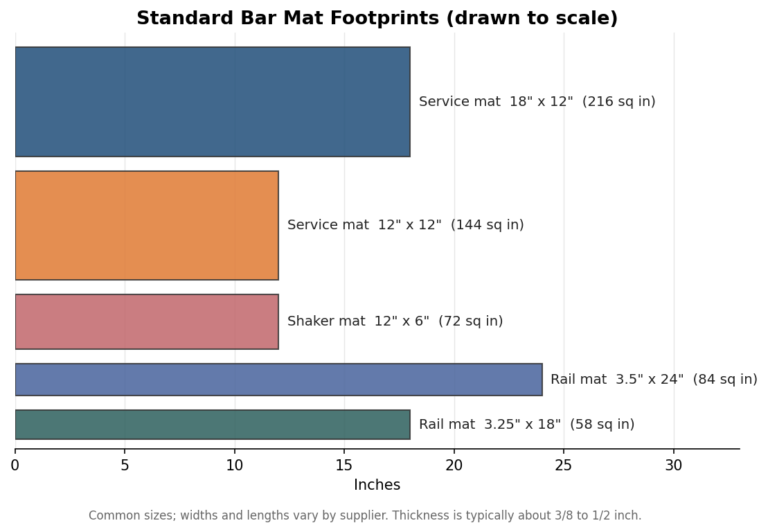
Size is where most home buyers go wrong, usually by picking the skinny mat they have seen behind a bar without realizing it is built for a narrow speed rail. Bar mats come in two broad shapes. A rail mat is long and narrow, commonly around 3.25 to 3.5 inches wide and 24 to 30 inches long, and it is designed to run along the edge of a pour station where the bartender lines up glasses. A countertop or service mat is a wider rectangle, with roughly 12 by 18 inches being the size that fits most home bar counters without overhanging or crowding your glasses. The footprint chart makes the difference concrete: a rail mat and a countertop mat are not the same product at different prices, they are different tools.
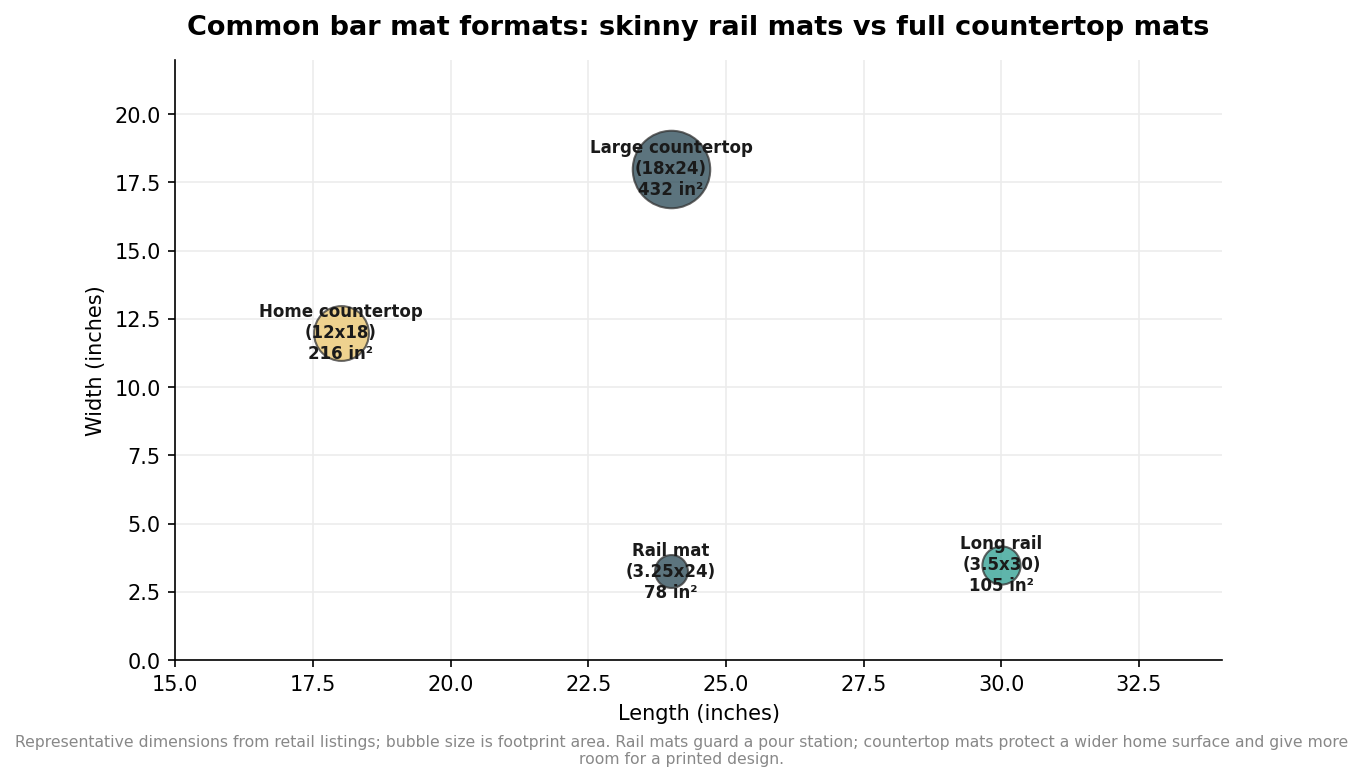
For a home bar, decide by what you are protecting. If you have a dedicated pour spot where you build drinks, a rail mat there keeps drips off the wood. If you want to protect a broader stretch of counter, or you are setting out bottles and a shaker for a gathering, a countertop mat in the 12-by-18 range does more. A larger mat, around 18 by 24 inches, suits a serious home bar or a coffee station with a machine and grinder, and it has the happy side effect of giving a custom print far more room to look good. Measure the actual open area before ordering, and remember the mat should sit comfortably inside the space, not fight your glass rack for room.
Material, thickness, and the details that matter
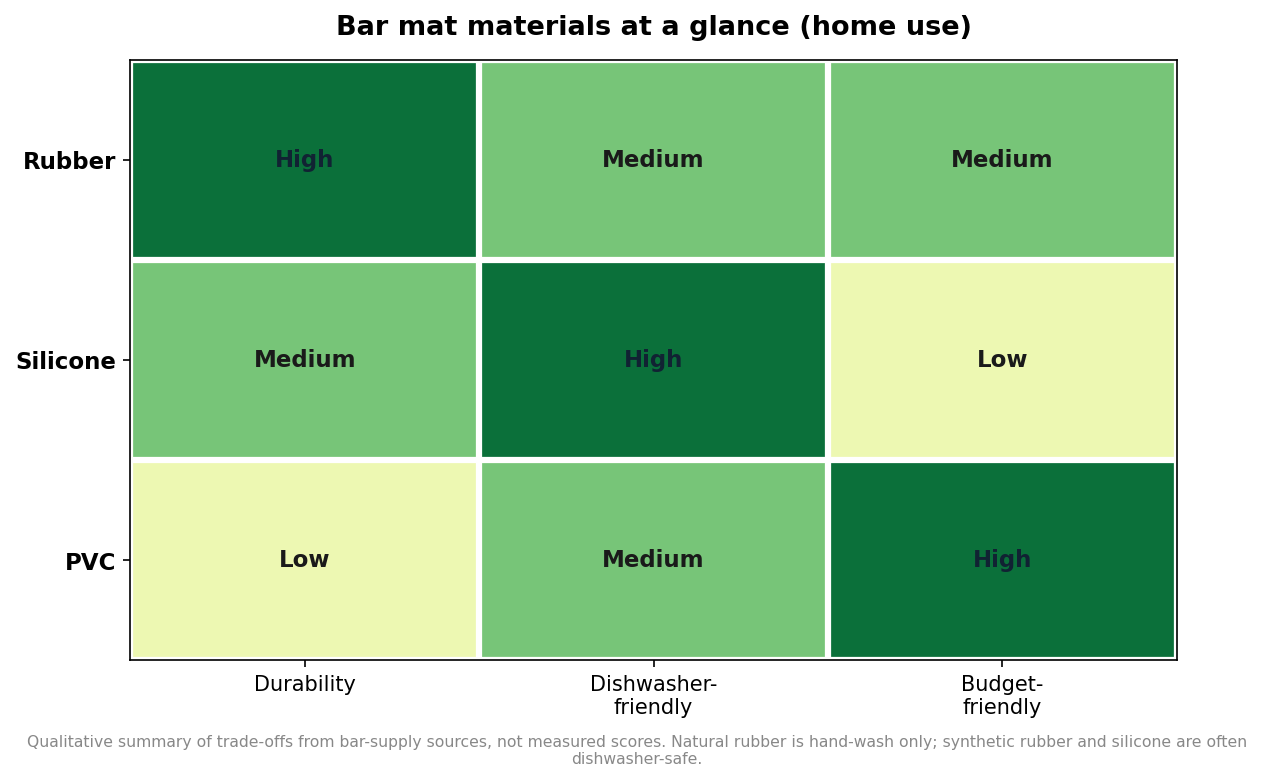
Three materials dominate, and the trade-offs are straightforward. Rubber is the industry standard and consistently outperforms the alternatives in real bar use for durability and grip. Silicone is more flexible and the easiest to clean, often simply going in the dishwasher, at a higher price and with a slightly less planted feel. PVC is the budget option and fine for light use, but it degrades faster than either. The matrix below sums up the trade-offs at a glance for a home buyer weighing them.
Beyond material, look at three build details. Thickness in the neighborhood of three-eighths of an inch is the sweet spot: enough to cushion a set-down glass and to hold spills rather than letting them sheet off the edge. Spill capacity follows from that, and a quality mat should be able to hold several ounces, on the order of four or more, before it overflows, which is what saves your counter when a full cocktail tips. Grip on both faces is the detail people forget: a textured top keeps bottles from sliding while a ribbed underside keeps the mat itself from wandering on the counter, and studs or ridges on the surface let liquid drain under the glass so the rim is not sitting in a puddle. A mat that skips these feels cheap the first time a bottle skates across it.
Personalizing a home bar mat
The custom angle is where a home bar mat stops being a utility item and becomes something people actually want. A mat printed with a family name, a home-bar nickname, a favorite team, or a small business logo turns a functional rubber rectangle into a centerpiece, and it is a reliably well-received gift for anyone who has built out a bar cart or a garage pub. Branded distilleries and breweries have sold home-bar rail mats as merchandise for exactly this reason.
A few design habits keep a custom mat looking sharp. Give the artwork room by choosing a size with enough surface for the design to breathe rather than cramming a logo onto a narrow rail. Favor bold, simple artwork with good contrast, since fine detail and thin lines get lost in a molded or printed rubber surface and are harder to read across a room. Black backgrounds remain the most popular choice for home bars because they hide the inevitable stains and match almost any decor, so design with the working life of the mat in mind, not just how it looks on day one. If you are ordering for a group or an event, a single strong design on a countertop-size mat reads better than a busy one shrunk onto a rail.
Care and placement
Cleaning is where the material choice comes back around. Synthetic rubber such as neoprene or nitrile, and silicone, are often dishwasher-safe, which makes upkeep effortless. Natural rubber is happier hand-washed and should be kept away from the dishwasher and from bleach, which can break it down over time. For any mat, a rinse with mild detergent and warm water, or an equal mix of water and white vinegar for odors, handles routine cleaning; the point is to empty and rinse it before spills dry and get sticky.
Placement is the last small decision. Put the mat where drinks are actually built or set down, keep it back from the very edge so a bumped glass lands on rubber rather than the floor, and let it dry fully before stacking anything on it. Do that, match the size and material to how your home bar really gets used, and a good mat quietly protects the counter, steadies the pour, and looks the part, which is everything you want from the least glamorous accessory on the bar.