Bar Mat Durability: How Long Custom Rubber Mats Last Behind the Bar
Bar Mat Durability: How Long Custom Rubber Mats Last Behind the Bar
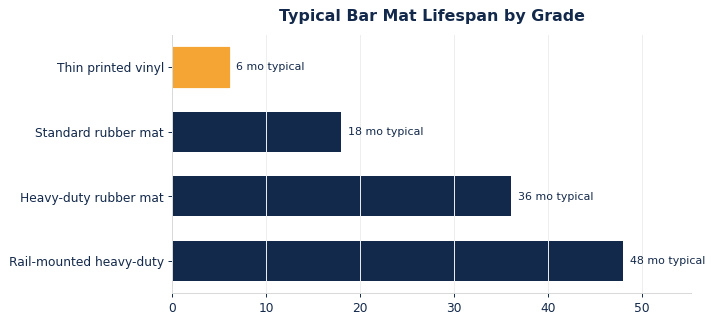
Ask ten bar owners how long a bar mat should last and you’ll get ten different answers, mostly because they’re comparing very different products. Bar mat durability depends far more on rubber grade and where the mat sits than most buyers assume — a thin printed vinyl mat behind a busy service well might not survive a summer, while a heavy-duty rubber mat on the same rail can run three or four years before it needs replacing. Knowing the real lifespan gap helps you budget correctly instead of guessing.
This guide breaks down what actually drives bar mat durability, how lifespan differs by placement behind the bar, and how to choose a mat grade that matches your volume instead of overpaying or under-buying.
What actually determines how long a bar mat lasts
Rubber thickness and density are the biggest factors in bar mat durability. A thin, lightweight mat compresses and cracks under repeated foot and glassware traffic far faster than a heavy-duty mat with real rubber depth, because there’s simply less material to absorb the wear before it breaks down. Standard commercial rubber mats sit in the middle — a solid, common choice that balances cost against a reasonable multi-year lifespan.
UV exposure, chemical contact from cleaning solutions and spilled alcohol, and constant flexing from foot traffic all accelerate wear beyond simple thickness. A mat near a sunny window or patio door degrades faster than the same mat in a dim, climate-controlled interior bar, and a mat that gets scrubbed daily with harsh cleaners breaks down faster than one wiped with a milder solution. The lifespan chart below shows typical service life by mat grade under regular commercial use.
Rail-mounted mats last longest
A rail-mounted rubber mat — secured directly to the bar rail rather than sitting loose on the floor or counter — tends to outlast a loose mat of the same grade, because it isn’t sliding, curling at the edges, or absorbing the extra wear of being repositioned throughout a shift. If your bar layout allows it, mounting is one of the simplest ways to extend the life of an already-durable mat.
How placement changes the wear pattern
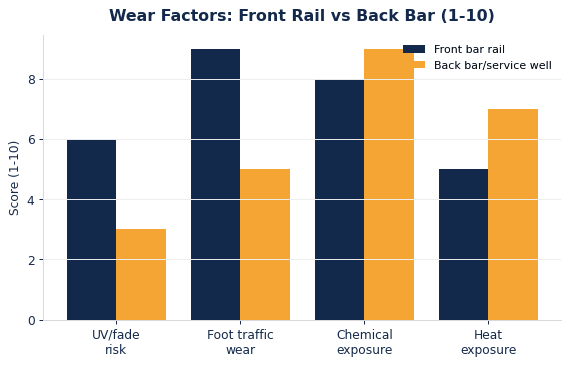
Not every foot of bar rail wears the same way. The front rail — where guests lean, glasses get set down, and sunlight often reaches through windows — takes the brunt of UV fade and general foot traffic. The back bar and service well see less UV exposure but far more chemical contact from cleaning, spilled spirits, and constant glassware handling during a rush.
Knowing which wear factor dominates in each zone helps you choose the right mat grade for that specific spot rather than buying one uniform mat for the whole bar. The chart below breaks down how UV, foot traffic, chemical exposure, and heat differ between the front rail and the back bar.
Choosing a mat grade for your volume
The table below matches mat grade to bar volume, since overpaying for heavy-duty rubber in a low-traffic spot wastes budget just as under-buying in a high-traffic spot wastes money on early replacement.
| Bar volume | Recommended grade | Expected lifespan |
|---|---|---|
| Low-volume/lounge | Standard rubber mat | 18–24 months |
| High-volume cocktail bar | Heavy-duty rubber mat | 3–4 years |
| 24/7 or high-traffic venue | Rail-mounted heavy-duty | 4+ years |
Budget for a scheduled replacement rather than waiting for visible failure — a cracked or curling mat becomes a slip hazard before it becomes an obvious eyesore. For mat specs suited to cocktail bars and speakeasies specifically, see our companion Custom Bar Mats for Cocktail Bars & Speakeasies: Spill Control & Branding, and browse grades across our custom bar mats range, or read about us for a durability comparison across our full lineup.
Building a replacement budget instead of reacting to failure
Most bars end up replacing mats reactively — only after a manager notices a cracked edge or a guest nearly slips — which means the expense always arrives as an unplanned surprise rather than a predictable line item. Once you know the typical lifespan for your specific mat grade and placement, converting that into a simple annual or biannual replacement budget turns an unpredictable expense into a routine one, and it means mats get swapped before they become a genuine safety issue rather than after.
Tracking install dates, even with something as simple as a label on the underside of each mat, makes this budgeting far easier than trying to remember when a given mat was last replaced. A quick annual walk-through checking install dates against expected lifespan for that grade tells you which mats are approaching replacement before they visibly fail, which lets you order proactively instead of scrambling for a rush replacement during a busy season.
Bars with multiple locations benefit from standardizing mat grade and replacement cadence across every site, both for consistency and for negotiating leverage on a larger combined order. A regional or multi-unit operator ordering heavy-duty rail-mounted mats across ten locations on the same schedule typically gets a better per-unit price than ten separate small orders placed whenever each individual manager happens to notice wear.
Note install dates on the mat itself
A simple marker note or label on the underside of a new mat, recording the install date, makes future replacement planning far easier than relying on memory. It takes seconds and pays off every time you do a lifespan review.
When comparing suppliers, ask directly about warranty terms and what counts as a defect versus expected wear, since this distinction gets murky in practice and matters a lot to a bar’s replacement budget. A supplier who stands behind a heavy-duty mat with a real multi-year warranty is signaling confidence in their own durability numbers, while one who’s vague about lifespan or offers no warranty at all is a signal worth taking seriously before committing to a large order. A clear warranty also gives you a documented reference point if a mat fails well short of its expected lifespan.
Finally, weigh mat durability against total cost of ownership rather than sticker price alone when comparing quotes. A heavy-duty mat that costs noticeably more upfront but lasts twice as long as a standard mat is usually the cheaper choice per year of service once you divide price by expected lifespan, even though it looks like the pricier option on a single-order quote. Asking a supplier for their expected lifespan by grade, and doing that simple per-year math yourself, is the clearest way to compare options that otherwise look similar on price alone.
Frequently asked questions
How long should a commercial bar mat last?
A standard rubber mat typically lasts 18 to 24 months under regular use; a heavy-duty rubber mat, especially rail-mounted, can run three to four years or more before it needs replacing.
Does mat placement really affect how long it lasts?
Yes — a mat near sunlight or a busy service well wears faster from UV and chemical exposure than one in a dim, low-traffic spot, even at the same rubber grade.
Planning mat replacements?
Tell us your bar volume and layout and we’ll recommend a mat grade built to last.