Bar Mat Thickness Guide: Choosing 8mm, 10mm or 12mm
Bar Mat Thickness Guide: Choosing 8mm, 10mm, or 12mm
It is easy to overlook, but bar mat thickness decides how much a mat can catch, how well it protects glassware, and how flat it lays on the bar. Choosing between 8mm, 10mm, and 12mm comes down to your volume and where the mat sits. This guide explains bar mat thickness so you spec a mat that handles your spills without curling or crowding the rail.
Thicker is not always better — a heavy 12mm mat catches more but can feel bulky on a tight cocktail rail. Match thickness to the station.
Thickness by station
Cocktail rails and retail displays do well with a slim 8mm mat; service wells suit 10mm; high-volume bars and glass-rinse zones benefit from a robust 12mm. The guide below maps thickness to use.
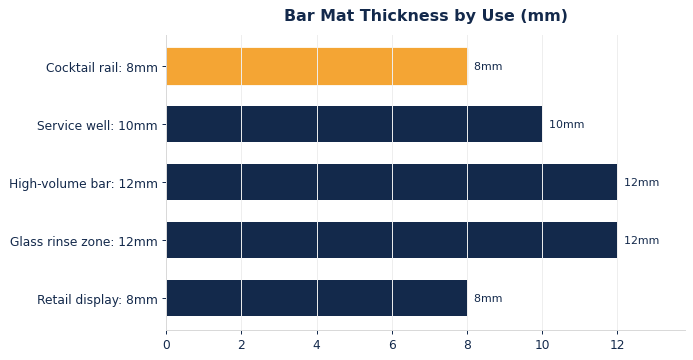
If you are unsure, 10mm is the versatile middle ground that works across most stations without feeling either flimsy or bulky.
How thickness affects performance
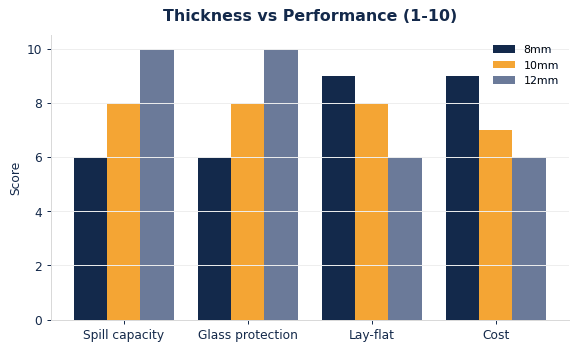
Thicker mats hold more spill and cushion glassware better but lay slightly less flat and cost more; thinner mats lay flat and cost less but catch less. The scores below compare 8mm, 10mm, and 12mm.
Material and branding
Rubber is the durable standard at any thickness; a deboss or 3D-raised logo reads cleanly and holds up to washing. Whatever thickness you choose, confirm the logo area and drainage channel layout so branding does not block the spill flow.
| Station | Thickness | Why |
|---|---|---|
| Cocktail rail | 8mm | Lay flat, slim |
| Service well | 10mm | Balanced |
| High-volume | 12mm | Max spill/protect |
Deciding where each mat goes? See our companion guide, our Rail Mats vs Service Mats: Where Each Belongs Behind the Bar. Explore our custom bar mats, about us, or get a quote.
How thickness affects spill capacity and cleanup
A bar mat’s thickness is really a measure of how much liquid it can hold before it overflows onto the bar top, which is why busy stations lean thicker. A 12mm mat has deeper channels and a higher wall than an 8mm mat, so it catches more spills, ice melt, and rinse water between empties, keeping the working surface drier through a rush. On a slow cocktail rail, an 8mm mat empties less often anyway, so the extra capacity is unnecessary and the slimmer profile lays flatter.
Cleanup routines interact with thickness too. A thicker mat holds more before it needs to be lifted and rinsed, reducing mid-shift interruptions at a high-volume well, but it is also heavier and takes a moment longer to handle. Matching thickness to how often a station realistically gets emptied keeps the bar dry without making cleanup harder than it needs to be, which is the practical balance behind the numbers.
Material and thickness working together
Thickness and material are a combined decision, because the same millimeter rating feels different across compounds. Dense rubber at 10mm feels substantial and grips the bar, while a softer compound at the same thickness may compress underfoot. For most bars, a quality rubber mat in the right thickness balances durability, grip, and a professional look, and it stands up to the constant exposure to citrus, alcohol, and washing that a bar mat endures.
The finish and texture also affect performance at a given thickness. A textured surface helps grip glassware and keeps bottles from sliding, while raised or debossed branding adds visual interest without blocking the drainage channels that let a thick mat do its job. Choosing the material and surface alongside the thickness ensures the mat performs as well as it measures on paper.
Branding a mat without hurting drainage
Bar mats are prime branding real estate, especially rail mats facing the guest, but the logo has to coexist with the mat’s function. A debossed or raised-3D logo reads cleanly and holds up to washing, and placing it so it does not block the drainage channels keeps spills flowing to the drip edge rather than pooling on the artwork. Thicker mats give a bit more room for a bold 3D logo, which is one reason branded rail mats often use a substantial build.
Design choices should keep both branding and function in mind. Confirming the logo area, channel layout, and mat size together before ordering prevents a great-looking mat that puddles, or a highly functional mat with a logo lost in the channels. When branding and drainage are planned together, a thick, well-designed mat markets the bar and keeps the station dry at the same time.
Sizing and speccing a set for your bar
Thickness is one dimension; footprint is the other, and a good order specs both per station. Measure the rail length and well footprint so mats fit the space without gaps or overhang, then choose thickness by how hard each station works. A slim mat lines the cocktail rail, a mid or thick mat sits in the high-volume well, and consistent branding ties the set together. Speccing the whole bar at once keeps the look cohesive and the fit correct.
Ordering a coordinated set also improves economics and reordering. Per-mat cost drops with quantity, so outfitting every station together is efficient, and keeping the spec — footprint, thickness, material, and logo — on file makes replacing a worn mat a simple repeat. A little planning delivers mats that fit each station, catch the spills they need to, and carry the brand where guests see it.
Common questions about bar mat thickness
What thickness bar mat do I need?
Use a slim 8mm mat for cocktail rails and displays, 10mm for service wells, and a robust 12mm for high-volume bars and glass-rinse zones. If unsure, 10mm is the versatile middle ground that works across most stations without feeling flimsy or bulky.
Does a thicker mat really catch more spills?
Yes. A thicker mat has deeper channels and a higher wall, so it holds more spill, ice melt, and rinse water before overflowing, keeping the bar top drier through a rush. On slow stations that empty rarely, the extra capacity is unnecessary.
Will a logo interfere with a mat’s drainage?
Not if it is designed correctly. A debossed or raised-3D logo placed so it does not block the drainage channels keeps spills flowing to the drip edge. Thicker mats give more room for a bold 3D logo, so confirm the logo area and channel layout together before ordering.
What material is best for a bar mat?
Quality rubber is the durable standard at any thickness, gripping the bar and standing up to citrus, alcohol, and washing. A textured surface helps hold glassware, and the material should be chosen alongside the thickness for the best performance.
How do I spec mats for a whole bar?
Measure each station’s rail length and well footprint, choose thickness by how hard the station works, and keep branding consistent across the set. Ordering the whole bar at once keeps the look cohesive, improves pricing, and makes reorders a simple repeat.
Speccing bar mats for your bar?
We’ll match thickness and branding to each station and your volume.
Get a QuoteBar Mat Thickness Guide: Choosing 8mm, 10mm, or 12mm
It is easy to overlook, but bar mat thickness decides how much a mat can catch, how well it protects glassware, and how flat it lays on the bar. Choosing between 8mm, 10mm, and 12mm comes down to your volume and where the mat sits. This guide explains bar mat thickness so you spec a mat that handles your spills without curling or crowding the rail.
Thicker is not always better — a heavy 12mm mat catches more but can feel bulky on a tight cocktail rail. Match thickness to the station.
Thickness by station
Cocktail rails and retail displays do well with a slim 8mm mat; service wells suit 10mm; high-volume bars and glass-rinse zones benefit from a robust 12mm. The guide below maps thickness to use.
If you are unsure, 10mm is the versatile middle ground that works across most stations without feeling either flimsy or bulky.
How thickness affects performance
Thicker mats hold more spill and cushion glassware better but lay slightly less flat and cost more; thinner mats lay flat and cost less but catch less. The scores below compare 8mm, 10mm, and 12mm.
Material and branding
Rubber is the durable standard at any thickness; a deboss or 3D-raised logo reads cleanly and holds up to washing. Whatever thickness you choose, confirm the logo area and drainage channel layout so branding does not block the spill flow.
| Station | Thickness | Why |
|---|---|---|
| Cocktail rail | 8mm | Lay flat, slim |
| Service well | 10mm | Balanced |
| High-volume | 12mm | Max spill/protect |
Deciding where each mat goes? See our companion guide, our Rail Mats vs Service Mats: Where Each Belongs Behind the Bar. Explore our custom bar mats, about us, or get a quote.
How thickness affects spill capacity and cleanup
A bar mat’s thickness is really a measure of how much liquid it can hold before it overflows onto the bar top, which is why busy stations lean thicker. A 12mm mat has deeper channels and a higher wall than an 8mm mat, so it catches more spills, ice melt, and rinse water between empties, keeping the working surface drier through a rush. On a slow cocktail rail, an 8mm mat empties less often anyway, so the extra capacity is unnecessary and the slimmer profile lays flatter.
Cleanup routines interact with thickness too. A thicker mat holds more before it needs to be lifted and rinsed, reducing mid-shift interruptions at a high-volume well, but it is also heavier and takes a moment longer to handle. Matching thickness to how often a station realistically gets emptied keeps the bar dry without making cleanup harder than it needs to be, which is the practical balance behind the numbers.
Material and thickness working together
Thickness and material are a combined decision, because the same millimeter rating feels different across compounds. Dense rubber at 10mm feels substantial and grips the bar, while a softer compound at the same thickness may compress underfoot. For most bars, a quality rubber mat in the right thickness balances durability, grip, and a professional look, and it stands up to the constant exposure to citrus, alcohol, and washing that a bar mat endures.
The finish and texture also affect performance at a given thickness. A textured surface helps grip glassware and keeps bottles from sliding, while raised or debossed branding adds visual interest without blocking the drainage channels that let a thick mat do its job. Choosing the material and surface alongside the thickness ensures the mat performs as well as it measures on paper.
Branding a mat without hurting drainage
Bar mats are prime branding real estate, especially rail mats facing the guest, but the logo has to coexist with the mat’s function. A debossed or raised-3D logo reads cleanly and holds up to washing, and placing it so it does not block the drainage channels keeps spills flowing to the drip edge rather than pooling on the artwork. Thicker mats give a bit more room for a bold 3D logo, which is one reason branded rail mats often use a substantial build.
Design choices should keep both branding and function in mind. Confirming the logo area, channel layout, and mat size together before ordering prevents a great-looking mat that puddles, or a highly functional mat with a logo lost in the channels. When branding and drainage are planned together, a thick, well-designed mat markets the bar and keeps the station dry at the same time.
Sizing and speccing a set for your bar
Thickness is one dimension; footprint is the other, and a good order specs both per station. Measure the rail length and well footprint so mats fit the space without gaps or overhang, then choose thickness by how hard each station works. A slim mat lines the cocktail rail, a mid or thick mat sits in the high-volume well, and consistent branding ties the set together. Speccing the whole bar at once keeps the look cohesive and the fit correct.
Ordering a coordinated set also improves economics and reordering. Per-mat cost drops with quantity, so outfitting every station together is efficient, and keeping the spec — footprint, thickness, material, and logo — on file makes replacing a worn mat a simple repeat. A little planning delivers mats that fit each station, catch the spills they need to, and carry the brand where guests see it.
Common questions about bar mat thickness
What thickness bar mat do I need?
Use a slim 8mm mat for cocktail rails and displays, 10mm for service wells, and a robust 12mm for high-volume bars and glass-rinse zones. If unsure, 10mm is the versatile middle ground that works across most stations without feeling flimsy or bulky.
Does a thicker mat really catch more spills?
Yes. A thicker mat has deeper channels and a higher wall, so it holds more spill, ice melt, and rinse water before overflowing, keeping the bar top drier through a rush. On slow stations that empty rarely, the extra capacity is unnecessary.
Will a logo interfere with a mat’s drainage?
Not if it is designed correctly. A debossed or raised-3D logo placed so it does not block the drainage channels keeps spills flowing to the drip edge. Thicker mats give more room for a bold 3D logo, so confirm the logo area and channel layout together before ordering.
What material is best for a bar mat?
Quality rubber is the durable standard at any thickness, gripping the bar and standing up to citrus, alcohol, and washing. A textured surface helps hold glassware, and the material should be chosen alongside the thickness for the best performance.
How do I spec mats for a whole bar?
Measure each station’s rail length and well footprint, choose thickness by how hard the station works, and keep branding consistent across the set. Ordering the whole bar at once keeps the look cohesive, improves pricing, and makes reorders a simple repeat.
Speccing bar mats for your bar?
We’ll match thickness and branding to each station and your volume.
Get a Quote