Rail Mats vs Service Mats: Where Each Belongs Behind the Bar
Rail Mats vs Service Mats: Where Each Belongs Behind the Bar
Behind a well-run bar, every mat has a job, and knowing rail mats from service mats keeps the station organized and the spills contained. A bar rail mat runs along the front edge where drinks are built and handed off; a service mat sits in the well where bartenders work and glasses are staged. This guide explains where each belongs and how to spec a set.
Using the right mat in the right spot speeds service and protects both glassware and the bar top — and a custom logo on the rail mat puts your brand right where guests look.
Rail mats: the guest-facing workhorse
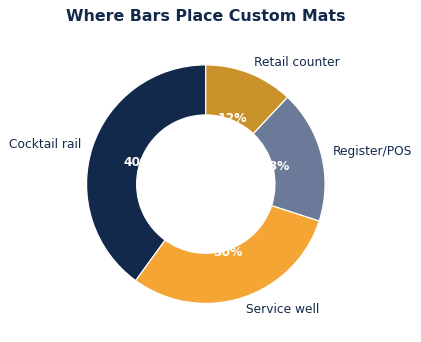
The bar rail mat is long and narrow, designed to line the drink rail where cocktails are built and set down. Because guests see it, it is the prime spot for a logo — a branded rail mat markets your bar every time a drink is served.
Service mats: the working surface
Service mats are wider and sit in the well, catching drips as bartenders pour and stage glasses. Here, spill capacity and glass cushioning matter more than branding, so a thicker mat often makes sense.
Speccing a matched set
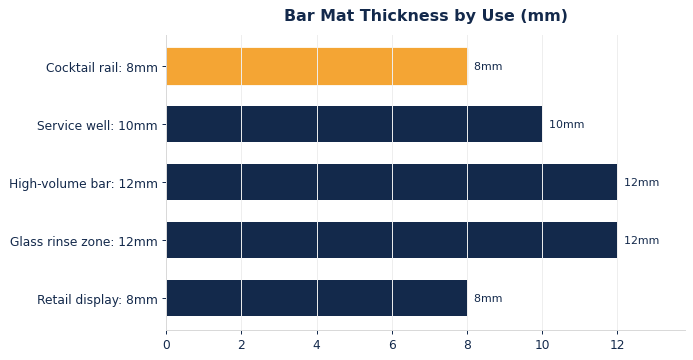
Measure your rail length and well footprint, then choose thickness by station (slim for the rail, thicker for the well). Keep the logo on the rail mat and confirm drainage channels so spills flow to the drip edge, not onto the floor.
| Mat | Location | Priority |
|---|---|---|
| Rail mat | Front drink rail | Branding |
| Service mat | Well | Spill/cushion |
| Register mat | POS | Small, branded |
Not sure how thick to go? See our companion guide, our Bar Mat Thickness Guide: Choosing 8mm, 10mm or 12mm. Explore our custom bar mats, about us, or get a quote.
How mats organize the flow of a busy bar
Behind a well-run bar, mats do more than catch spills — they organize the workflow, and knowing rail from service mats is part of that system. The rail mat defines the build-and-hand-off zone at the front edge, giving bartenders a consistent place to construct drinks and set them for pickup, while the service mat defines the working well where pouring and glass staging happen. Using each mat for its intended zone keeps the station orderly under pressure, which speeds service and reduces spills.
This division of labor also protects the bar and the guest experience. A defined rail keeps finished drinks off the raw bar top and out of the well’s splash zone, while the service mat contains the drips and pours of active work. When each mat anchors its part of the flow, the whole station runs cleaner and faster, which is exactly what a bar needs during a rush.
Where branding belongs in the system
Because the rail mat faces the guest, it is the bar’s prime branding surface, and putting the logo there means it markets the bar every time a drink is served. A debossed or 3D logo on the rail mat reads cleanly and survives washing, turning a functional mat into a visible brand asset. The service mat, hidden in the well, prioritizes spill capacity and glass cushioning over branding, so it often goes unbranded or lightly marked.
Splitting branding this way lets each mat play to its strength: a striking branded rail mat on the guest side and a heavier, function-first service mat in the well. This is why many bars order the two as a coordinated but distinct pair rather than identical mats, getting marketing where it is seen and durability where it is needed.
Thickness and material by mat role
The two mat roles often call for different builds. A rail mat can be slimmer since it mainly catches build spills and hands off drinks, and a slim profile lays flat and clean on the guest-facing edge. A service mat benefits from more thickness to hold the heavier drips and rinse water of the working well and to cushion glasses set down hard, reducing chipped rims over a shift. Speccing each mat’s thickness for its role optimizes both.
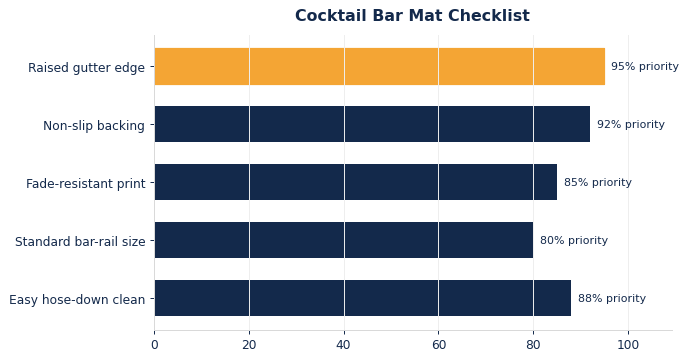
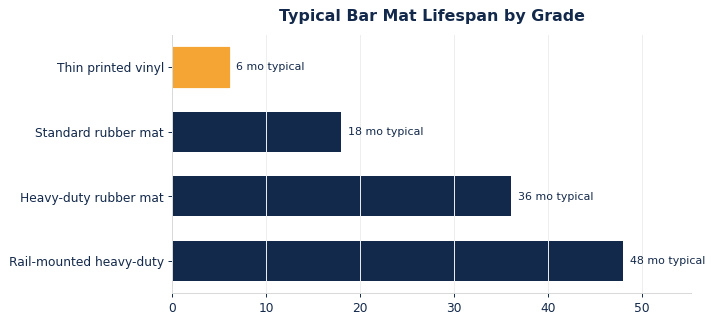
Material choice supports these roles. Durable rubber suits both, with a textured surface to grip glassware in the well and a clean face for branding on the rail. Confirming the drainage channel layout on each mat ensures spills flow to the drip edge rather than pooling, so both mats keep their zones dry. Matching build to role gives you a set where each piece does its job well.
Speccing a matched rail-and-service set
A coordinated order starts with measuring both zones — the rail length and the well footprint — so each mat fits without gaps or overhang. From there, choose a slim branded rail mat and a thicker, function-first service mat, plus any register or POS mats you want branded. Ordering the set together keeps the branding cohesive on the guest side and the performance right in the well, and it simplifies fitting the whole station at once.
Ordering as a set also helps cost and reordering. Per-mat pricing improves with quantity, so buying the rail, service, and register mats together is efficient, and keeping the spec on file makes replacing a worn mat a quick repeat. Planning the set as a system delivers a bar that looks branded where it counts and stays dry where it works.
Common questions about rail and service mats
What is the difference between a rail mat and a service mat?
A rail mat is long and narrow, lining the front drink rail where cocktails are built and handed off, while a service mat is wider and sits in the well where bartenders pour and stage glasses. Each anchors a different zone of the bar’s workflow.
Which mat should carry the logo?
The rail mat, because it faces the guest and markets the bar every time a drink is served. A debossed or 3D logo on the rail mat reads cleanly and survives washing, while the hidden service mat prioritizes spill capacity over branding.
Should rail and service mats be different thicknesses?
Often yes. A rail mat can be slimmer since it mainly catches build spills, while a service mat benefits from more thickness to hold heavier drips and cushion glasses in the well. Speccing thickness by role optimizes both mats.
Can I order rail and service mats as a set?
Yes, and it is the recommended approach. Measuring both zones and ordering a slim branded rail mat with a thicker service mat, plus any register mats, keeps branding cohesive and performance right. Ordering the set together also improves pricing.
How do I keep both mats draining properly?
Confirm the drainage channel layout on each mat, and keep any logo from blocking the channels, so spills flow to the drip edge rather than pooling. Proper channel design lets both the rail and service mats keep their zones dry.
Setting up your bar stations?
We’ll spec a matched rail-and-service mat set with your logo where it counts.
Get a QuoteRail Mats vs Service Mats: Where Each Belongs Behind the Bar
Behind a well-run bar, every mat has a job, and knowing rail mats from service mats keeps the station organized and the spills contained. A bar rail mat runs along the front edge where drinks are built and handed off; a service mat sits in the well where bartenders work and glasses are staged. This guide explains where each belongs and how to spec a set.
Using the right mat in the right spot speeds service and protects both glassware and the bar top — and a custom logo on the rail mat puts your brand right where guests look.
Rail mats: the guest-facing workhorse
The bar rail mat is long and narrow, designed to line the drink rail where cocktails are built and set down. Because guests see it, it is the prime spot for a logo — a branded rail mat markets your bar every time a drink is served.
Service mats: the working surface
Service mats are wider and sit in the well, catching drips as bartenders pour and stage glasses. Here, spill capacity and glass cushioning matter more than branding, so a thicker mat often makes sense.
Speccing a matched set
Measure your rail length and well footprint, then choose thickness by station (slim for the rail, thicker for the well). Keep the logo on the rail mat and confirm drainage channels so spills flow to the drip edge, not onto the floor.
| Mat | Location | Priority |
|---|---|---|
| Rail mat | Front drink rail | Branding |
| Service mat | Well | Spill/cushion |
| Register mat | POS | Small, branded |
Not sure how thick to go? See our companion guide, our Bar Mat Thickness Guide: Choosing 8mm, 10mm or 12mm. Explore our custom bar mats, about us, or get a quote.
How mats organize the flow of a busy bar
Behind a well-run bar, mats do more than catch spills — they organize the workflow, and knowing rail from service mats is part of that system. The rail mat defines the build-and-hand-off zone at the front edge, giving bartenders a consistent place to construct drinks and set them for pickup, while the service mat defines the working well where pouring and glass staging happen. Using each mat for its intended zone keeps the station orderly under pressure, which speeds service and reduces spills.
This division of labor also protects the bar and the guest experience. A defined rail keeps finished drinks off the raw bar top and out of the well’s splash zone, while the service mat contains the drips and pours of active work. When each mat anchors its part of the flow, the whole station runs cleaner and faster, which is exactly what a bar needs during a rush.
Where branding belongs in the system
Because the rail mat faces the guest, it is the bar’s prime branding surface, and putting the logo there means it markets the bar every time a drink is served. A debossed or 3D logo on the rail mat reads cleanly and survives washing, turning a functional mat into a visible brand asset. The service mat, hidden in the well, prioritizes spill capacity and glass cushioning over branding, so it often goes unbranded or lightly marked.
Splitting branding this way lets each mat play to its strength: a striking branded rail mat on the guest side and a heavier, function-first service mat in the well. This is why many bars order the two as a coordinated but distinct pair rather than identical mats, getting marketing where it is seen and durability where it is needed.
Thickness and material by mat role
The two mat roles often call for different builds. A rail mat can be slimmer since it mainly catches build spills and hands off drinks, and a slim profile lays flat and clean on the guest-facing edge. A service mat benefits from more thickness to hold the heavier drips and rinse water of the working well and to cushion glasses set down hard, reducing chipped rims over a shift. Speccing each mat’s thickness for its role optimizes both.
Material choice supports these roles. Durable rubber suits both, with a textured surface to grip glassware in the well and a clean face for branding on the rail. Confirming the drainage channel layout on each mat ensures spills flow to the drip edge rather than pooling, so both mats keep their zones dry. Matching build to role gives you a set where each piece does its job well.
Speccing a matched rail-and-service set
A coordinated order starts with measuring both zones — the rail length and the well footprint — so each mat fits without gaps or overhang. From there, choose a slim branded rail mat and a thicker, function-first service mat, plus any register or POS mats you want branded. Ordering the set together keeps the branding cohesive on the guest side and the performance right in the well, and it simplifies fitting the whole station at once.
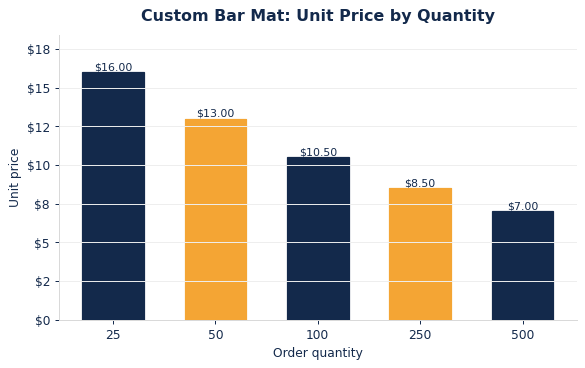
Ordering as a set also helps cost and reordering. Per-mat pricing improves with quantity, so buying the rail, service, and register mats together is efficient, and keeping the spec on file makes replacing a worn mat a quick repeat. Planning the set as a system delivers a bar that looks branded where it counts and stays dry where it works.
Common questions about rail and service mats
What is the difference between a rail mat and a service mat?
A rail mat is long and narrow, lining the front drink rail where cocktails are built and handed off, while a service mat is wider and sits in the well where bartenders pour and stage glasses. Each anchors a different zone of the bar’s workflow.
Which mat should carry the logo?
The rail mat, because it faces the guest and markets the bar every time a drink is served. A debossed or 3D logo on the rail mat reads cleanly and survives washing, while the hidden service mat prioritizes spill capacity over branding.
Should rail and service mats be different thicknesses?
Often yes. A rail mat can be slimmer since it mainly catches build spills, while a service mat benefits from more thickness to hold heavier drips and cushion glasses in the well. Speccing thickness by role optimizes both mats.
Can I order rail and service mats as a set?
Yes, and it is the recommended approach. Measuring both zones and ordering a slim branded rail mat with a thicker service mat, plus any register mats, keeps branding cohesive and performance right. Ordering the set together also improves pricing.
How do I keep both mats draining properly?
Confirm the drainage channel layout on each mat, and keep any logo from blocking the channels, so spills flow to the drip edge rather than pooling. Proper channel design lets both the rail and service mats keep their zones dry.
Setting up your bar stations?
We’ll spec a matched rail-and-service mat set with your logo where it counts.
Get a Quote