Custom Bar Mats for Cocktail Bars & Speakeasies: Spill Control & Branding
Custom Bar Mats for Cocktail Bars & Speakeasies: Spill Control & Branding
A busy cocktail bar spills constantly — shaken drinks, muddled fruit, a fast pour that overshoots the glass — and every one of those spills either lands on a mat built to handle it or seeps into the wood underneath. Bar mats for cocktail bars exist to take that daily punishment so the actual bar surface doesn’t have to, and a well-chosen mat quietly does its job for years without a guest ever noticing it’s there. A cheap one, by contrast, curls, slides, and stains within a season.
This guide covers what a cocktail bar actually needs from a rail mat, how to balance spill control with a speakeasy’s design aesthetic, and how to spec a mat that holds up behind a high-volume rail.
What a cocktail bar rail mat needs to do
Cocktail service is harder on a mat than beer or wine service, because shaken and muddled drinks throw more liquid, pulp, and ice around the rail than a simple pour. The core job of bar mats for cocktail bars is containing that mess — a raised gutter edge keeps liquid from running off onto the floor or a bartender’s shoes, and a solid non-slip backing keeps the mat itself from sliding during a fast Friday-night rush.
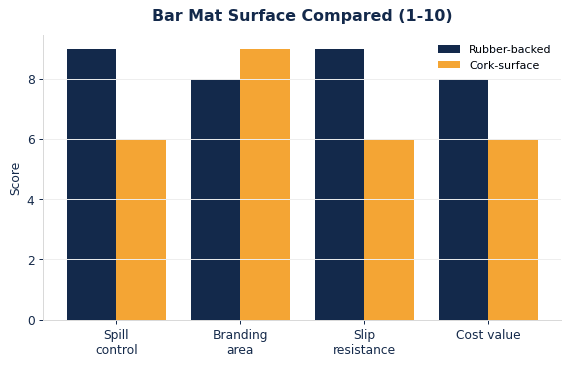
Surface texture matters too: a mat that’s too smooth gets slick with citrus and simple syrup residue, while a well-textured rubber surface stays grippy enough for a bartender to set down glassware and tools confidently mid-shift. The chart compares rubber-backed and cork-surface mats on what cocktail bars weigh most.
Balancing durability with speakeasy aesthetics
A speakeasy or design-forward cocktail bar cares about how the mat looks as much as how it performs, since the rail is often part of the visual experience. A rubber-backed mat with a deep, matte-black or brand-colored surface and a subtle embossed or printed logo delivers spill control without looking like a dive-bar utility mat — the goal is a mat that reads as intentional, not tacked on.
Spec’ing branding that survives spills
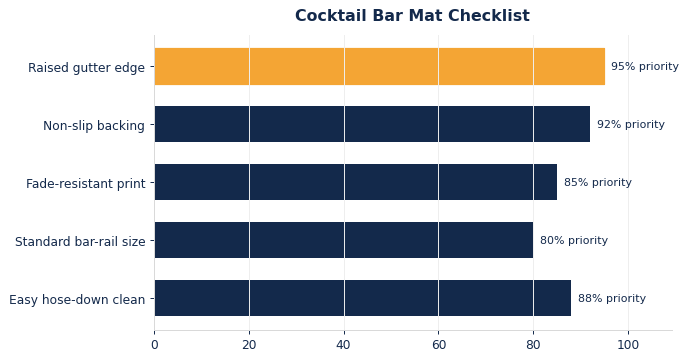
Printed logos on a rail mat take constant abrasion from glassware, bar tools, and cleaning, so print method matters as much as the mat material. A logo molded or debossed into the rubber itself survives indefinitely since there’s no ink layer to wear away, while a printed logo needs a UV-stable, fade-resistant ink to hold up under bar lighting and regular hose-down cleaning.
The checklist below is what we walk cocktail bar buyers through before approving a design, since these are the details that separate a mat that looks sharp on day one from one that still looks sharp a year in.
Ordering for your rail
The table below is a simple way to plan a rail mat order by bar size and service style.
| Bar type | Recommended mat | Branding |
|---|---|---|
| Speakeasy/design-forward | Rubber, matte finish | Debossed or subtle logo |
| High-volume cocktail bar | Rubber, deep gutter edge | Bold single-color print |
| Service well/back bar | Rubber, utility grade | Minimal or no branding |
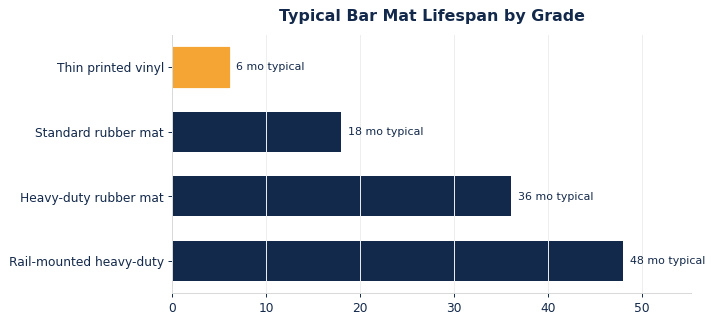
Measure your rail length precisely before ordering — a mat that’s slightly short leaves a gap where spills escape, and one that’s too long curls at the edge. For how long different mat grades hold up under real bar volume, see our companion Bar Mat Durability: How Long Custom Rubber Mats Last Behind the Bar, and browse current styles across our custom bar mats range, or read about us before placing your order.
Fitting mats into the daily cleaning and reset routine
A cocktail bar’s mat only performs well if it’s actually maintained between shifts, and the mats that hold up longest are the ones built into a bar’s existing cleaning routine rather than treated as an afterthought. A quick hose-down or wipe-down at close, rather than letting citrus and syrup residue sit overnight, prevents the slow buildup that eventually stains even a well-made rubber mat. Training new bartenders on this step during onboarding matters as much as the mat’s material quality.
Storage between uses affects lifespan more than most bar managers expect. A mat left curled or folded in a storage closet develops a permanent bend that never fully flattens back out on the rail, creating a slight ridge that catches glassware and looks worn well before the rubber itself has actually degraded. Hanging or laying mats flat during any extended downtime, like a seasonal closure or a slow renovation period, preserves the flat profile that makes a mat sit correctly on the rail.
Replacing mats on a rotation, rather than waiting for visible failure, keeps a cocktail bar’s rail looking consistently sharp instead of having one obviously newer mat next to several faded ones. Staggering replacement — swapping a third of the rail’s mats every few months rather than the whole set at once — spreads the cost out and avoids a jarring visual difference between old and new sections of the bar.
Keep a cleaning product on the approved list
Not every bar cleaner is safe for rubber mats long-term; some harsh degreasers accelerate cracking. Confirm with your supplier which cleaning products are safe for your specific mat grade and keep that list posted near the bar.
Seasonal or pop-up cocktail bars have a slightly different mat need than a permanent rail, since the mat may need to be installed and removed repeatedly rather than staying put for years. A lighter, more portable rubber mat that still delivers real spill control but rolls or folds without permanent creasing suits a rooftop bar, a seasonal patio program, or an event bar that only operates part of the year. Asking specifically for a mat rated for repeated setup and breakdown, rather than the same heavy-duty mat built for a permanent installation, avoids paying for durability the seasonal setup won’t actually use.
Multi-location cocktail bar groups benefit from standardizing rail mat specs the same way they’d standardize glassware or POS systems, both for a consistent guest experience and for negotiating leverage on a combined order. A regional group ordering the same rubber grade, gutter depth, and branding across every location typically secures a better per-unit price than each bar manager sourcing independently, and it means a guest visiting a second location gets the same tactile, branded experience at the rail rather than a noticeably different one.
Frequently asked questions
What’s the best surface for a cocktail bar mat?
A textured rubber-backed mat with a raised gutter edge is the standard for cocktail service, since it contains spills and stays grippy even when covered in citrus and syrup residue.
Can a bar mat still look upscale for a speakeasy?
Yes — a matte-black or brand-colored rubber mat with a debossed or subtly printed logo delivers full spill control without looking like a utility mat behind a design-forward bar.
Spec’ing mats for your bar?
Send your rail dimensions and style and we’ll spec bar mats built for cocktail service.