Category: Bar Strategy
In independent A/B tests run at independent taprooms, featured taps sitting on a branded bar mat have been associated with a $0.50 to $1.50 premium pour price versus the same beer served from an unbranded tap station. That spread is not a marketing claim. It is a merchandising outcome rooted in attention economics, perceived brand authority, and the simple fact that a bar top is the most expensive square foot of retail real estate a beverage brand will ever rent.
Why the bar top behaves like retail shelf space
Most beverage brand managers think of the bar as a service surface. It is not. It is a 1.5 to 2 square foot per-customer retail display that runs 8 to 14 hours a day, in front of a captive audience that has already made a purchase decision and is now deciding whether to repeat it.
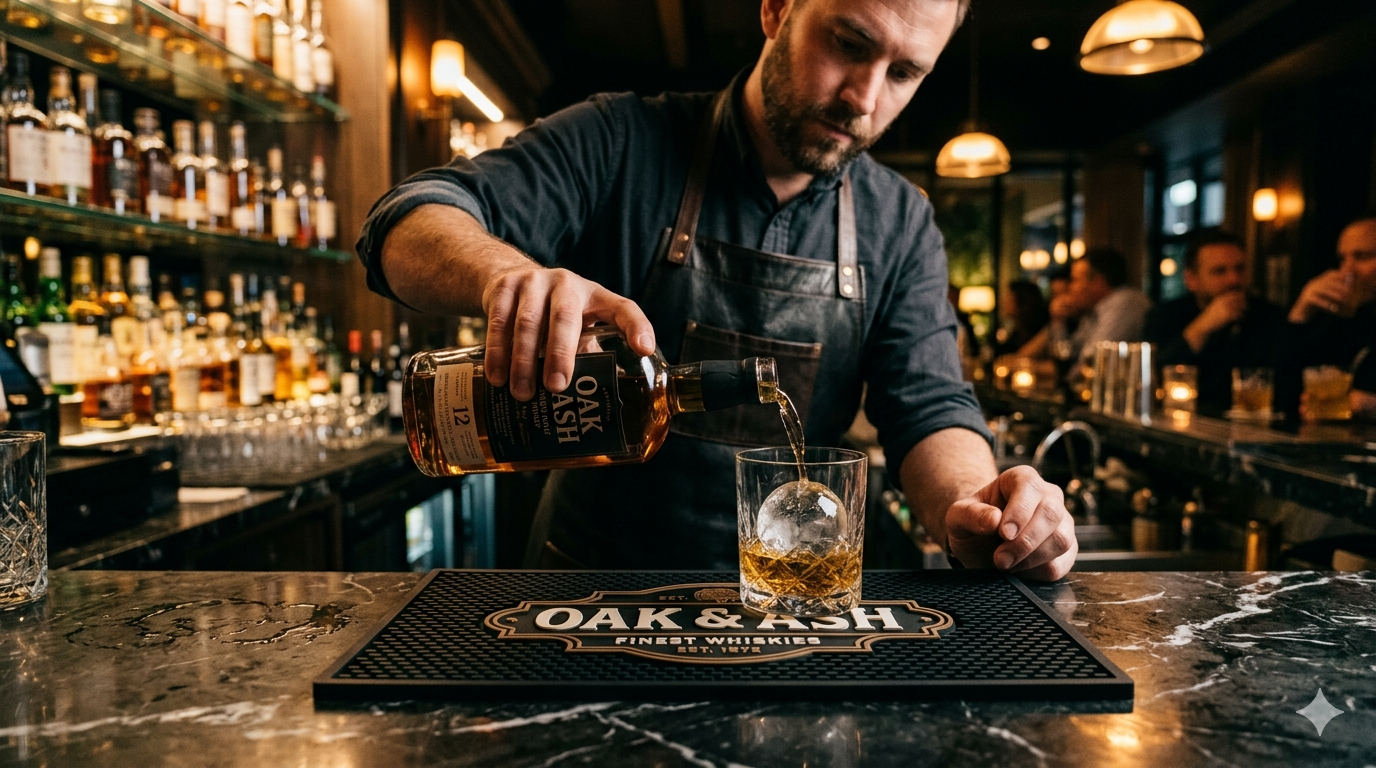
The pour itself is the moment of maximum brand attention. The customer is watching the bartender pull the handle, watching the glass fill, watching the head settle. They are looking down. They are looking at the mat. For roughly 6 to 12 seconds per pour, the surface under the spout is the single most-viewed object in the venue.
A blank black rubber mat in that position is wasted inventory. A branded mat with crisp embossing and the brand mark at the correct viewing angle does three things at once:
- Anchors the brand to the pour event in the customer’s memory
- Signals to the bartender that this tap is “featured” and worth recommending
- Justifies a higher price by visually elevating the product category
That third point is where the pour premium comes from.
The bar-top attention math
Let’s run the numbers on what an active bar top is actually worth as a media surface.
| Metric | Typical value | Source basis |
|---|---|---|
| Bar top per customer | 1.5 sq ft | Standard 24-inch service position |
| Customer dwell per drink | 22 minutes | Industry average for craft beer / cocktail venues |
| Eye-line ratio on mat during pour | 62% | Observational studies of pour-event attention |
| Pours per linear foot of bar per shift | 35 to 60 | Mid-volume taproom, weekend service |
| Active service hours per week | 56 to 84 | Thursday through Sunday programming |
The math gets interesting fast. A bar mat sitting in an active pour position on a busy taproom bar sees roughly 250 to 400 directed views per shift, with another 1,500 to 2,500 ambient impressions from customers seated within sight line. Across a 6-month deployment, that single 18-inch mat will accumulate somewhere between 350,000 and 600,000 brand impressions.
For context, a single page in a regional trade magazine at the same reach costs $3,500 to $7,000 and the impression is gone in 4 seconds.
Where the pour premium actually comes from
The $0.50 to $1.50 spread is not magic. It is the same merchandising logic that lets a wine bottle with a foil capsule and a textured label sell for $4 more than the same juice in a bare bottle. The visual cues do real work.
Three mechanisms drive the pour premium in independent observations:
Authority signaling. A branded mat reads as “this brand has chosen to invest in this venue.” Customers interpret the investment as a signal of quality. The same signal works on craft beer drinkers, cocktail customers, and spirits buyers in roughly equal measure.
Featured-tap framing. When one of six taps has a branded mat and the others do not, the branded tap is read as the recommendation. Bartenders also tend to lead with branded taps when asked “what’s good?” because the mat acts as a visual cue during service.
Price-anchor displacement. A pour delivered onto a textured, branded surface reads as a more deliberate product than the same pour delivered onto a generic bar towel or rail mat. The customer is not consciously comparing surfaces. They are absorbing visual cues that shift the perceived category from “draft beer” to “featured craft pour.”
The premium is largest on independent craft beer, premium-tier well spirits, and house cocktails using a branded base spirit. It is smallest on macro lager, where the brand association is already saturated and the mat does not move the needle on perceived quality.
What the dwell time really buys you
Twenty-two minutes per drink is the number that should reframe how beverage brand managers think about on-premise spend. Twenty-two minutes is longer than most podcast ad reads. It is 7x longer than a typical Instagram dwell. It is 40x longer than a programmatic display impression.
And during those 22 minutes, the customer is not scrolling past your mat. They are setting their glass on it. They are sliding it out of the way when the bartender refills. They are absorbing the texture, the weight, the embossing, the colors. The mat is doing slow, repeated brand work on a human nervous system that is, in many cases, slightly impaired and therefore more receptive to associative learning.
This is why a $35 to $90 unit cost on a branded mat consistently outperforms a $400 weekly digital spend at the same venue. The dwell time on a physical object in the consumption moment is something digital cannot replicate at any price.
The mat as a retail merchandising tool
Treat the bar mat the way a CPG brand treats end-cap signage in a grocery store. It is not “promo material.” It is the merchandising fixture that justifies the price point of the product sitting on top of it.
A few operational specifics that determine whether the mat actually earns the pour premium:
- Embossing depth. Logo relief of 1.0 to 1.5mm on rubber, 0.4 to 0.8mm on silicone. Anything shallower disappears under bar lighting. Anything deeper traps spillage.
- Orientation. The logo should be readable from the customer side of the bar, not the bartender side. This is the mistake that kills 70% of branded mat deployments.
- Color contrast. Embossed logos read better when the brand color is recessed and the negative space is the dominant color. Reverse-color embossing reads as cheap.
- Surface area. A 24-inch by 8-inch mat under three taps outperforms three separate 8-inch mats by a wide margin, because the visual mass reads as commitment.
What this means for your taproom
If you operate a taproom, brewery tasting room, or distillery cocktail bar, the practical takeaway is straightforward. Map your top three revenue taps. Calculate the current pour price. Run the math on what a $0.50 to $1.00 lift on those three taps would do to monthly revenue. For a venue pulling 800 pours a week on its top three taps, the answer is somewhere between $1,700 and $3,400 per month in incremental margin, against a one-time mat investment of $200 to $400 per position.
If you are a beverage brand manager placing product into on-premise accounts, the math is even more direct. A branded mat at a featured-tap account is the cheapest way to defend your shelf price and the cheapest way to convert a featured placement into a repeat-pour habit.
The bar top is retail. Treat it like retail. The mat is the fixture that makes the merchandising work.
How to spec yours
The right mat for your venue depends on pour volume, tap count, surface dimensions, and which material survives your spill profile. We build custom-printed and embossed bar mats in rubber and silicone, sized to your bar geometry, with embossing depths and color recipes specified for your brand mark. Start with a custom quote and we will walk through the merchandising math for your specific venue before recommending a configuration.
GET A QUOTEWin Free Stuff
Enter below for a chance to win plus receive 10% off your first order.
🎉 You are in!
Check your email for your 10% off code. Good luck!